Worshipping Together – Apart

Dear All,
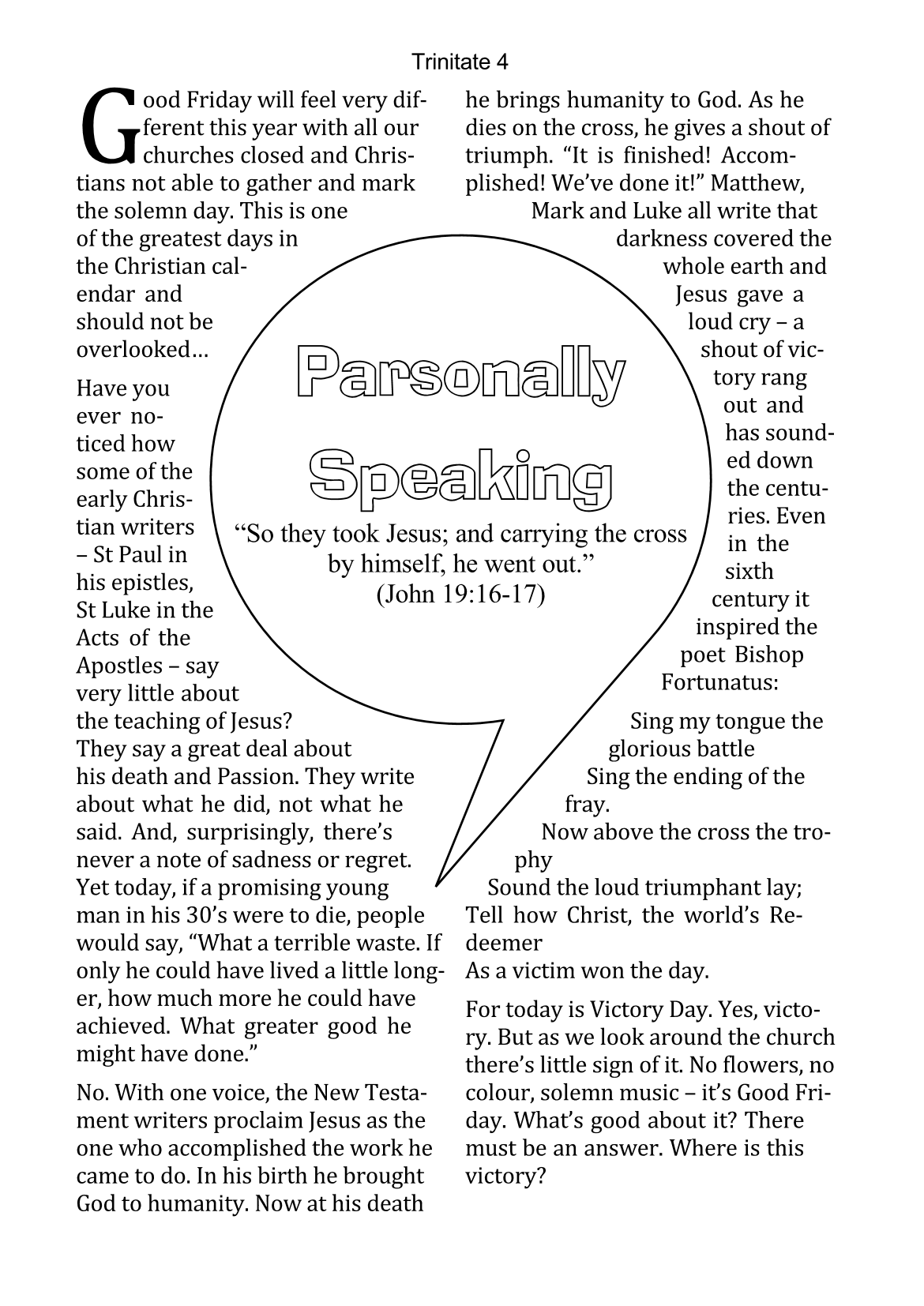
Here then is this week’s Bible Reading and some thoughts on it. You will see that once again I have placed it in the centre of an informal Service of Eucharist which you can use at home, alone or with your family – wherever you do it you will in fact be worshipping together (with so many others) though apart. On Easter Sunday morning many of you will have seen or heard the Archbishop of Canterbury celebrating the Communion with his wife in their own kitchen so have no qualms about doing so yourself today in yours. I used a Poppy and Sesame cracker as my ‘bread’ and had a slurp of the Bucks Fizz with which I was celebrating the end of the Lenten fast as my ‘wine’ on that day. There are no rules, use what you have to hand, make your kitchen table your altar and following Christ’s instruction to remember him in this way you will find that, perhaps unexpectedly you too ‘recognise him at the breaking of the bread.’
With every blessing
Keep separate, keep safe
But remember you are never separated from the love of God or from the prayers of us all
Mary Tucker

A Service to say at home
Call to Worship

The Lord be with you
And also with you
God in Jesus has revealed his glory
Come let us worship together
From the rising of the sun to its setting
The Lord’s name is greatly to be praised

(Hymn – Sing something you enjoy!!)

Prayer of Confession

Holy God we bring you ourselves
All that we are and all that we long to be
Our weakness, our failures, our sinfulness and our brokenness

Son of Mary Have mercy on us
Carpenter of Nazareth Have mercy on us
Healer of the sick Have mercy on us
Bringer of light Have mercy on us
Saviour of the poor Have mercy on us
Bread of life Have mercy on us
You who call us sister, brother, friend Have mercy on us
Your body and Spirit with us
Holy God we bring you ourselves
All that we are and all that we long to be
Our weakness, our failures, our sinfulness and our brokenness
Have mercy on us

Bible Reading – read Luke 24:13-35
The Walk to Emmaus

Now on that same day two of them were going to a village called Emmaus, about seven miles from Jerusalem, and talking with each other about all these things that had happened. While they were talking and discussing, Jesus himself came near and went with them, but their eyes were kept from recognizing him. And he said to them, “What are you discussing with each other while you walk along?” They stood still, looking sad. Then one of them, whose name was Cleopas, answered him, “Are you the only stranger in Jerusalem who does not know the things that have taken place there in these days?” He asked them, “What things?” They replied, “The things about Jesus of Nazareth, who was a prophet mighty in deed and word before God and all the people, and how our chief priests and leaders handed him over to be condemned to death and crucified him. But we had hoped that he was the one to redeem Israel. Yes, and besides all this, it is now the third day since these things took place. Moreover, some women of our group astounded us. They were at the tomb early this morning, and when they did not find his body there, they came back and told us that they had indeed seen a vision of angels who said that he was alive. Some of those who were with us went to the tomb and found it just as the women had said; but they did not see him.” Then he said to them, “Oh, how foolish you are, and how slow of heart to believe all that the prophets have declared! Was it not necessary that the Messiah should suffer these things and then enter into his glory?” Then beginning with Moses and all the prophets, he interpreted to them the things about himself in all the scriptures.
As they came near the village to which they were going, he walked ahead as if he were going on. But they urged him strongly, saying, “Stay with us, because it is almost evening and the day is now nearly over.” So he went in to stay with them. When he was at the table with them, he took bread, blessed and broke it, and gave it to them. Then their eyes were opened, and they recognized him; and he vanished from their sight. They said to each other, “Were not our hearts burning within us while he was talking to us on the road, while he was opening the scriptures to us?” That same hour they got up and returned to Jerusalem; and they found the eleven and their companions gathered together. They were saying, “The Lord has risen indeed, and he has appeared to Simon!” Then they told what had happened on the road, and how he had been made known to them in the breaking of the bread.

This is the Word of the Lord. Thanks be to God.

Some Thoughts on the Reading

Recognising Jesus at the Breaking of the Bread

Many years ago now we were staying in a posh hotel down in Devon, very near the place where they were shooting the film, ‘Ladies in Lavender’, with Judy Dench and Maggie Smith, a most unlikely place for us to be it has to be said.

We, along with the rest of the family, had been summoned, in an ‘Agatha Christie like’ way, to this cliff top venue by my Mother in Law (long gone now but much loved and missed.)

It’s OK, no one was actually murdered (though I do remember a few tense moments as she ordered us about with the authority of the one who was paying the bill), but something extremely embarrassing did happen.

Dressed to the nines, and most uncomfortable, my husband and I were proceeding through the grand entrance hall towards the dining room when, coming towards us, I spied a familiar face. The trouble was,
that, though I knew I knew him, for the life of me I couldn’t think who it was! As we closed on each other
I did what I always do on these increasingly frequent occasions (I think it’s an age thing), I smiled broadly and confidently, exuding, I hoped, absolute certainty of who this was and, as we drew near to each other said what I always say in these situations, “Hello! How nice to see you. How are you?”

I was aware of two things immediately. One was a strange gasp from my husband at my side, the other, a momentary look of confusion on the face of my approaching friend. “Ha!” I thought, “It’s not just me!” I thought. Put someone in the wrong environment and we can all find it difficult to place them. He pulled himself together quickly however, and as we passed, smiled back with equal confidence and replied, “I’m fine thanks and how are you?”

As neither of us had received the necessary clues to identity we perhaps hoped for and which would have enabled us to chat further, we both kept moving, passed, and continued on our opposite courses, me still wracking my brains to place my associate.

My thoughts however were rudely interrupted by the hoarse and embarrassed whisper of my long suffering spouse who, red in the face and horrified, said, “What did you do that for?”

I started to explain about my ‘not being able to place a friend in a strange place’ technique but, before I could go on, he said, “But you don’t know him, it was Charles Dance, he’s a famous actor!”

Well how was I supposed to know the cast of the film were staying there? I’m just relieved it wasn’t Maggie Smith! Who’d want to be on the receiving end of one of her Downton-esque put downs?!

When I read today’s Gospel passage, the thing that really struck me was the weirdness of the two disciples not recognising the man they’d been with for the last days, weeks, possibly years. It didn’t seem to make sense.

In the BBC series ‘The Passion’, made in 2010 I think and watched by me again this last Holy Week, they had the risen Jesus played by a different actor on the road at the beginning of this story and then changed him back to the original one at the breaking of the bread.

That, I have to say, just didn’t feel right to me and I continued to worry away at how on earth they couldn’t have recognised him when the true tale I’ve just told you came to mind.

Walking through that hotel foyer, I was so taken up with not making a fool of myself by admitting to someone I thought I knew that I couldn’t for the life of me remember who they were, that actually, really and truly, my ‘eyes were closed’, I was ‘kept from recognising’ a really famous face I knew well, and ended up making an even greater fool of myself!

The disciples had a similar reaction once they recognised Jesus and he had gone. They couldn’t believe that they hadn’t known who it was. “Didn’t our hearts burn within us?” they gasped in amazement at their own blindness. But they had been so taken up with their grief and their disappointment at the apparent failure of all they had thought Jesus stood for, that their eyes were closed, they were kept from recognising a really familiar face. I’m sure they too felt really foolish, but that feeling was far outweighed by their joy at the revelation they had received, so much so that they set off immediately on the return walk, of some 15 or 20 miles, to share their new found recognition with their friends. Lack of recognition, we must admit, is not so unusual or so inexplicable as we may at first have thought

The other possible interpretation of the words, “Their eyes were kept from recognising him.” is that this was part of the plan, part of God’s plan and we can empathise with this too. In things that happen in our lives, embarrassing things, unfortunate things, frightening things, even tragic things (and we are experiencing quite a lot of this at present), and whether we want to say they are part of God’s plan or just things that, having happened, are used by God, with hindsight we recognise that we have grown from the experience.

These disciples not only failed to recognise their Lord and leader in the resurrected flesh, but had also failed to recognise in their own scripture, ‘The law and the Prophets’, just what sort of a God they were dealing with. They had failed to recognise in the person of Jesus, through those days, weeks and perhaps years together, what sort of salvation he was going to bring.

Believing in a wrathful God who needed to be placated by sacrifice and careful keeping of the law, expecting a conquering hero who would drive out the Romans and re-establish Jewish supremacy, they could not recognise the ‘suffering servant God’ who loved them, who died to save them and in whose weakness was strength and absolute victory.

No wonder they went racing back! Not only were they taking the news that Jesus truly was alive, but a new understanding that their long talk with the unrecognised ‘stranger’ on the road had given them. And that, I suppose, is the message for us. We may not always be aware that God is at work. We may not recognise that the experiences we have, the people we meet (or pass at a distance!), the things we do, are all part of God’s plan or can and will be used by him in that plan. But it may well be, that in our prayer time in the cool of the evening or on a Sunday morning in the quiet of Church (yes it will come again), in the familiar words and at the breaking of the bread (on altar or kitchen table), things fall into place, our eyes are opened, and we are briefly and strongly aware of the Jesus who has walked with us, sometimes unrecognised but always there, every step, on the road of our lives.

Prayers

We pray to the Lord for courage as we walk, together but apart, the road of life.
In this unprecedented time of crisis, give your Church the courage to give up her preoccupation with herself and to give time to your mission in the world. Lord, help us to recognise you in our lives, give us strength and hear our prayer.
May the blood and water flowing from the side of Jesus bring forgiveness to your people and help us to face the cost of proclaiming salvation as we work together and apart in your damaged world. Lord, help us to recognise you in our lives, give us strength and hear our prayer.
Give your world the courage to give up war, bitterness and hatred, and to seek peace and healing for each other. Lord, help us to recognise you in our lives, give us strength and hear our prayer.
May the shoulders of the risen Jesus, once scourged by soldiers, bear the burden of our times. Lord, help us to recognise you in our lives, give us strength and hear our prayer.
Give us the courage to give up quarrels, strife and jealousy in our families, neighbourhoods and communities. Lord, help us to recognise you in our lives, give us strength and hear our prayer.
May the presence of the risen Jesus, his body once broken and now made whole, bring peace and direction as we live with one another. Give us the courage to give up our selfishness as we live for others, and to give time, care and comfort to the sick and those who care for them in ways that are safe for them and for us. Lord, help us to recognise you in our lives, give us strength and hear our prayer.
May the wounded hands of Jesus bring his healing touch to all who suffer, and the light of his presence fill their hearts and homes. Lord, help us to recognise you in our lives, give us strength and hear our prayer.
Give us the courage to give up our fear of death and to rejoice with those who have died in faith. May the feet of the risen Lord Jesus, once nailed to the cross, walk alongside the dying and bereaved in their agony, and walk with us and all your Church through death to the gate of glory. Lord, help us to recognise you in our lives, give us strength and hear our prayer, here and in eternity. Amen.

We pray with confidence as our Saviour has taught us
Our Father, who art in heaven,
Hallowed be thy Name.
Thy Kingdom come.
Thy will be done on earth, as it is in heaven.
Give us this day our daily bread.
And forgive us our trespasses,
As we forgive those who trespass against us.
And lead us not into temptation,
But deliver us from evil.
For thine is the kingdom, the power, and the glory, for ever and ever.
Amen

A Home Communion

Take bread and wine or juice and pray

Blessed are you O God
For you have brought forth bread from the earth
Blessed are you O God
For you have created the fruit of the vine
Here at your table
You offer us light, bread and wine for the journey
To nourish us as sons and daughters

Jesus took bread, and having blessed it
He broke it and gave it to his disciples saying
Take, eat, this is my body which is given for you
In the same way after supper, he took the cup of wine
And gave you thanks, he gave it to them saying
Drink this all of you, this is my blood of the new covenant
Which is shed for you and for many for the forgiveness of sins
So now, following Jesus’ example
We take this bread and this wine and pray

Lord Jesus Christ, present with us now
Breathe your Spirit upon us and upon this bread and wine
That they may be heaven’s food for us
Renewing, sustaining and making us whole
That we may be your body on earth
Loving and caring in the world

Look – The bread of heaven – The light of the world
Here is Christ, coming to us in bread and wine
The gift of God for the people of the world

The table of bread and wine is now made ready
It is the table of company with Jesus
So, come to this table, you who have much faith
And you who would like to have more
You who have been to this sacrament often
And you who have not been for a long time
You who have tried to follow Jesus
And you who have failed
Come – it is Christ himself who invites us to meet him here

Eat your bread and sip you drink and take a moment of quiet before praying

Concluding Prayer

Holy God, we have seen with our eyes
And touched with our hands the bread of life the light of the world
Strengthen our faith
That we may grow in love for you and for each other
Through Jesus Christ our Lord. Amen

And may the blessing of God Almighty the Father, the Son and the Holy Spirit be with us all, those we love and those we pray for. Amen
“Low Sunday” – Easter 2

In the normal course of the Church year, this Sunday is called “Low Sunday”, because everyone took time to recover from the rigours of the great fast of Lent and the joyful feast of Easter. Today must have the record low of all years since the founding of the one, holy, catholic and apostolic Church. Church attendance throughout Europe is at zero. There is no great congregation to celebrate the risen Christ together – only virtual gatherings. It is the “lowest Sunday” because of the corona virus. The lows we have reached have induced a new terror. Everyone’s fears have become real in the light of this disease – no one is immune, even the Prime Minister has succumbed. How can we be anything but “low”?

So, how can we rise? How will we resurrect ourselves from the low of this Sunday? I wonder, will the good habit of Church attendance be re-established when our forced isolation has been eased? Will we return to the building to worship and rejoice with each other when the ban on every congregation, small or great, has been lifted?

I hope we will gather in greater numbers – I don’t think we should remain low, because of this lack of being with one another. We should be learning self-sufficiency even if our being-with is deficient. It is only through being-with- one-another that we develop and learn. The lessons I want to understand from this politically enforced singularity focus on moral behaviour and good manners – two things which, I think, belong with each other, as they reflect each other. They show themselves in our actions toward one another. Morally, we understand ourselves only in relation to those ’round about us. Our morals must reveal themselves through our manner of behaving toward one another.

I think this time of isolation should teach us about how we should behave when we do get to embrace and greet one another in love, the love of people saved, the love of people grieving.

How can we consolidate our graciousness toward each other, how can we show our moral care for the other, except through good manners when we are with one another? The social distancing we have been practising has relieved us of the burden of any close caring contact. It is much harder to look someone in the eye to express any care, when you are two metres apart. How can we pass the peace apart from signing and bellowed speech, when we cannot touch each other, when we cannot reach each other’s heart through the nuanced modulation of speech? Good manners, I think, confirms the moral space we create for each other – the handshake affirms it, our tone sustains it – the embrace of the peace symbolises and substantiates all we believe about the love of God and one another.

“In great fear they cried out to the Lord.” In these times of the virus, when we are keeping ourselves to ourselves, as prescribed by law, don’t we cry out in our anxiety? The anxious hearts today reflect the hearts of the people in medieval Europe during the time of the Black Death. How are we to keep ourselves “safe”? How can we avoid the virus and the sinister dangers of depression and despair – those maladies which can insidiously root themselves into the heart of our lives? How can we be healthy when we are no longer with others in a positive manner? Haven’t we become hermits all too easily? This life of isolation has become the norm for so many of us. It has not really affected how we are deep in ourselves. Dropping contact, staying six feet apart has not changed some of us, has it? We shop remotely, we stay at home – no change there. Has this enforced separation really changed us fundamentally? I know that I am as comfortable now as I was before the “lock down” of this legislated isolation. But even though I have not felt so very different, it has made me realise my deficiencies – how negatively I have experienced life. Now I realise just how dismaying my life has been. Now I know the low manner of my life.

And surprisingly it seems that these negative ways of being with one another just seem to appear all of a sudden. We haven’t seen them coming, have we? They are like “the leaven of malice and wickedness” – quietly taking over the course of our lives, without our even noticing the direction our lives have taken. All of a sudden we realise what we are, where we have been thrown. I suddenly realise how spiteful and mean I have always been. What are we to do when we wake up to those realisations about ourselves, when those scales of unseeing fall from our eyes? How can I remain so despicable, as I recognise myself for what I am? How can I be so wicked, especially in this Easter season, when our Lord gave himself up on the cross, and now leads us to the joy of  salvation?

Our destination of heaven has been revealed in the old, old story. The Easter garden is where we understand just what our ownmost possibility is. But when our feet are mired in the clay of the garden, and we see clearly just what we are, then we come under the spotlight of our ownmost possibility. That finality stares us in the face. What are we to do?

Like the Danish theologian, we stand on a precipice, there is no safe place to retreat into – we are exposed and alone, isolated ultimately – we must make that leap of faith into a future of infinite possibility one way or another. At the focus of all time, I must choose – as the old Welsh hymn has it – between truth and falsehood to become what I should be, the culmination of my ownmost possibility, or live the ultimate lie. I reckon the lockdown has given us that  reality of our ownmost possibility.

The existential nihilists might say that this virus has forced us into the limits of who we are, and we must confront the nothingness of our existence. But that would give us no exit from the banality of an earthly life into any of the joyful mansions of the Father’s Kingdom.

We must leap into the bright future of Christ’s promise. Lent was when the government bans on gathering together, the closing of shops and pubs, the social distancing all took hold. We christians have been able to overcome the limitations of governmental recommendations because of our faith, let alone with the marvels of electronic communication.

What is our isolation today when compared to the isolation of Jesus on the cross in those last moments of Good Friday? The old, old story does not end there, in spite of some biblical scholars’ opinions. The old, old story continues in our hearts, where our faith lives. Not in the lowliness of our fear, but in the gracious love of Christ and one another which joins us together even if we are all two metres apart.

Amen

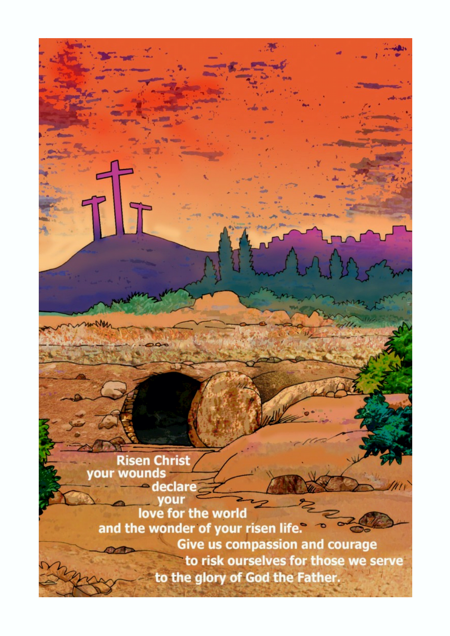
EASTER SUNDAY

Acts 10.34-43
In the house of a Roman centurion, Peter shares what God taught him in a vision: that forgiveness of sins is offered to all, whatever their background, if they believe in Jesus Christ, whom God anointed with the Holy Spirit and raised from the dead.
Peter began to speak: “I now realise how true it is that God does not show favouritism but accepts men from every nation who fear him and do what is right. You know the message God sent to the people of Israel, telling the good news of peace through Jesus Christ, who is Lord of all. You know what has happened throughout Judea, beginning in Galilee after the baptism that John preached – how God anointed Jesus of Nazareth with the Holy Spirit and power, and how he went around doing good and healing all who were under the power of the devil, because God was with him. “We are witnesses of everything he did in the country of the Jews and in Jerusalem. They killed him by hanging him on a tree, but God raised him from the dead on the third day and caused him to be seen. He was not seen by all the people, but by witnesses whom God had already chosen – by us who ate and drank with him after he rose from the dead. He commanded us to preach to the people and to testify that he is the one whom God appointed as judge of the living and the dead. All the prophets testify about him that everyone who believes in him receives forgiveness of sins through his name.”
Matthew 28:1-10
On Easter morning an angel rolls the stone away and tells the two women that Jesus is risen, and they must tell others. Jesus himself repeats the instructions, and both reassure them there is nothing to fear.

After the Sabbath, at dawn on the first day of the week, Mary Magdalene and the other Mary went to look at the tomb. There was a violent earthquake, for an angel of the Lord came down from heaven and, going to the tomb, rolled back the stone and sat on it. His appearance was like lightning, and his clothes were white as snow. The guards were so afraid of him that they shook and became like dead men.

The angel said to the women, “Do not be afraid, for I know that you are looking for Jesus, who was crucified. He is not here; he has risen, just as he said. Come and see the place where he lay. Then go quickly and tell his disciples: ‘He has risen from the dead and is going ahead of you into Galilee. There you will see him.’ Now I have told you.” So the women hurried away from the tomb, afraid yet filled with joy, and ran to tell his disciples.

Suddenly Jesus met them. “Greetings,” he said. They came to him, clasped his feet and worshipped him. Then Jesus said to them, “Do not be afraid. Go and tell my brothers to go to Galilee; there they will see me.”


“Do not be afraid.” (Matthew 28:5)

There is a delightful book by Martin Waddell and Barbara Firth entitled Can’t You Sleep, Little Bear? Little Bear’s problem is that he is scared of the dark. Big Bear provides bigger and bigger lanterns but nothing helps. Little Bear knows that outside the cave there is a lot of darkness, and the lanterns make no difference. Eventually Big Bear takes Little Bear outside to look up to the sky and face his fears. When Little Bear sees the moon and the stars, shining far above, splitting the darkness, he is at last able to fall asleep. Now, it’s natural to be afraid of the dark. But Matthew’s story of the resurrection tells us about people who were afraid of the light.

Sometimes, the darkness is easier to cope with. The disciples of Jesus had lived through a roller coaster of emotions during that first Holy Week. They had been carried along by the cheering crowds of Jesus’ entry into Jerusalem. They had spent the festival vigilant in the face of the risk to Jesus from the authorities – Jewish and Roman. They had experienced the intimacy of eating and drinking with Jesus and one another at the Passover supper. And then the fear, the shame, the despair and the grief of Jesus’ arrest, trial and horrific death. In those circumstances, the deadness of grief seems welcome. It offers the chance to retreat into the dark and to stop feeling for a while. There is comfort in the dark, and a certain bleak peace. So two women called Mary go early in the morning to a tomb they know to be secure and guarded. They go to grieve. The bright light of a Jerusalem morning may be shining around them, but there is darkness in their hearts. And perhaps there is comfort in that. Now that it is all over and the adventure of travelling with Jesus has come to an end, they can do what women do – weep for the dead, and tend to the living. They are sad, of course, devastated even, but they are not afraid, not any more. When the worst you feared has happened, there is no more reason to be afraid. So it is not the darkness that scares them out of their wits, but the light – the light from two figures who ought not to be there. One is from another world, an angel, who should not exist in the real world of a Jerusalem garden. The other – well the other should be dead. Both break into the darkness of grief and despair with a searing white light of hope and joy. And the women are afraid. Grief they understood, it has its rituals and its expectations, and they know what is expected. But this new thing, this unexpected joy, this painfully bright light, this is terrifying. In their grief the walk to the tomb has been long and slow. Now all is movement. They run from the angel and from the empty tomb, not knowing whether to scream or sing. And they run headlong into Jesus. Little wonder that they fall at his feet. And his first words to them echo the message of the angel earlier: “Do not be afraid; go and tell.” Each of the Gospel writers tells the story of the resurrection in a distinctive way. None of the Gospels attempts to tell us what happened to Jesus between Good Friday and Easter Day. That remains a mystery. Instead, the Gospel writers show us the effect of the resurrection on those who were there. Matthew’s account describes an earthquake and an angel like lightning. But he is not alone in describing the first reaction of those who experienced the resurrection as one of fear.

As Christians the world over sing alleluia on Easter Day, it’s probably not the fear of the first believers we are feeling, more like the events that have overtaken the world – events that have had an effect on all of our lives. But perhaps we should not completely lose sight of those first witnesses – they may even give us courage as we move forward in our lives. The women at the tomb were right to be afraid. A bright light had pierced the gloom of the world, and nothing – nothing would ever be the same again. Dark death had been overcome. All the old, comfortable certainties had failed. The world had been turned upside down. And there were consequences. No returning to the safety of simple domestic life for the two Marys, but a commission to spread the news. And no safety for us either, if the light pierces through our lives and into our hearts today, but a life committed to the truth. A life committed to making the message of Jesus real and active to all those we have contact with. The words to the women at the tomb are the words that Jesus speaks to us on this Easter day: “Do not be afraid; go and tell.”

COLLECT PRAYER

Lord of all life and power, who through the mighty resurrection of your Son overcame the old order of sin and death to make all things new in him: grant that we, being dead to sin and alive to you in Jesus Christ, may reign with him in glory; to whom with you and the Holy Spirit be praise and honour, glory and might, now and in all eternity. Amen.

A happy, courageous, and Christ-filled Easter to you all
Bill

Six Good Friday Reflections

from

David Runcorn

the cross

Reflection 1

(12.00)

“He opened wide his arms’ – the welcome of God”

Hymn – to sing or read

My song is love unknown,
My Saviour’s love to me;
Love to the loveless shown,
That they might lovely be.
O who am I,
That for my sake My Lord should take
Frail flesh, and die?

Reading

‘Now my soul is troubled. And what should I say – “Father, save me from this hour”? No, it is for this reason that I have come to this hour. Father, glorify your name.’ Then a voice came from heaven, ‘I have glorified it, and I will glorify it again.’ The crowd standing there heard it and said that it was thunder. Others said, ‘An angel has spoken to him.’ Jesus answered,

‘This voice has come for your sake, not for mine. Now is the judgement of this world; now the ruler of this world will be driven out. And I, when I am lifted up from the earth, will draw all people to myself.’ He said this to indicate the kind of death he was to die.

Jn 12.27-33

Reflection

Over the years the words we use in public worship have been revised. One of the newer sentences in the communion service has proved more popular than most. Perhaps it is yours too? It is the line, ‘He opened wide his arms on the cross.’

When someone opens their arms to you – what do you see?

What is being expressed?

What are you about to receive?

And how do you respond? – joy, love, delight, welcome – with open arms in return.

To be unable, or forbidden, to freely offer this in any time or place runs counter to our deepest instincts and feelings. But such is our context this Easter.

In this vigil at the foot of the cross we begin by imagining Jesus on the cross. His arms are opened wide towards us and our world.
Here is love that refuses to keep distance from us.

To imagine love in this place of such dreadful suffering is not easy. The focus is more often placed on judgement, guilt, punishment, debt and sacrifice. And they are all part of this story. But that focus too easily makes the cross a kind of extreme, divine problem solving – one which requires unspeakable suffering and death to deal with our sin.

Well the cross is a place of painful truths but that is not where the story starts. What is original to this world is not our sin or evil. It is divine love. When we begin with the negatives, focused on the problem, we never get out of the cycles of judgment and condemnation. No repentance is ever enough. No effort with make us acceptable.

It is true that human sin has made God’s embrace of us a work of tragic redemption … but it is love that holds him there. Love is reaching out to us at whatever cost. There is no distancing.

Jesus did not come to change the mind of God about humanity – “now you can love them after all”. Jesus came to change our mind about God.
God does not love us because we are good; God loves us because God is good.

This is welcome beyond any language of deserving – good or bad ….
The cross tells us that nothing we humans can do will ever decrease or increase God’s eternal eagerness to love us. Divine love is made visible here – forever.

So let us draw near to this love.

There is somewhere is this separated world where we have no need to keep our distance.

There is offered here an embrace unlike anything we have ever known.
It is beyond all imagining or any notions of deserving.

He opened wide his arms on the cross.

Where do you connect with these thoughts?

You might pause and keep silence for a few moments.

Prayer

O God, revealed upon the cross
through the open arms of your Son,
Your love is endless –
Your reach is boundless –
Your embrace knows no separation.
In wonder and gratitude, we turn to you –
and open our arms to receive your love –
A space to add your own prayers.
We adore you O Christ and we bless you
For by your Holy Cross
You have redeemed the world.

the cross

Reflection 2

(12.30)

‘The place called the skull‘ – the crucified God

Hymn – to read or sing

O sacred Head, now wounded,
With grief and shame weighed down,
Now scornfully surrounded
With thorns, Thine only crown;
O sacred Head, what glory
What bliss til now was
Thine Yet though despised and gory
I joy to call Thee mine.

Bernard of Clairvaux

Reading

‘As they went out, they came upon a man from Cyrene named Simon; they compelled this man to carry his cross. And when they came to a place called Golgotha (which means Place of a Skull), they offered him wine to drink, mixed with gall; but when he tasted it, he would not drink it. And when they had crucified him, they divided his clothes among themselves by casting lots; then they sat down there and kept watch over him. Over his head they put the charge against him, which read, “This is Jesus, the King of the Jews.”’

Matt 27.32-37

Reflection

Executions always took place outside the city, in places of maximum publicity, by the main routes into the city – as a warning and deterrent. That the sign above the cross of Jesus was in three languages (as we learn elsewhere) makes this clear.

This is a message and a signal.

Around the edge of any growing ancient city would have been quarries, close to the main roads, managing the endless demand for building material.

Occasionally the quarriers would come to a rock that was flawed or cracked – perhaps from earthquakes. They would chisel round and continue cutting back so that, over time, the quarry floor would have lumps and outcrops of damaged rock sticking out, standing alone, rejected by the builders.

One of these had attracted the name ‘skull’ – because that is what it looked like.

It was a place used for executions. It was by this rock, or upon it, that Jesus was crucified.

We know that for the first years after the death of Jesus, the Jerusalem Christians gathered by this stone on Easter day. That makes sense of the words of Peter,

‘Come to him, a living stone, though rejected by mortals yet chosen and precious in God’s sight, and like living stones, let yourselves be built into a spiritual house, to be a holy priesthood. “The stone that the builders rejected” has become the very head of the corner’.

1Peter 1.1&2.4-7

The first Christians were often from among the poor, the marginalised, the socially ‘worthless’. To such people comes this unexpected invitation. Come to Jesus. You too are like stones in the quarry, left behind like so much debris, odd shapes and flawed pieces no one found any use for; discarded after the powers have chosen the best by their measures of value and importance.

But you are, in fact, of great value.

Here at the place of the skull – we too come flawed, unpromising and far behind when judged by the preoccupations and obsessions of this present age.

But listen. All the usual measures of what makes us acceptable, impressive or even useful have been suspended – or rather reversed.

‘Come to him’, says Peter. Really?

This takes some trusting. We should expect anything built on such a foundation to look foolish, sound irrelevant, and be easy to mock and despise by any normal measure.

We will not be found on ‘Grand Designs’.

We will never be impressive building materials. But nor was Jesus.

He was a stone the builders rejected. If Jesus, the rejected one, is the foundation stone of life, we are being shown a completely different way of knowing ourselves and of seeing and knowing God. All that has been rejected and left behind as worthless must be seen in a new light.
Jesus, the stone the builders rejected, has become the foundation stone for the only building that really matters – the new humanity built upon his love.

Where do you connect with these thoughts?

You might pause and keep silence for a few moments.

Prayer

Christ our victim, rejected and cast aside as of no worth.
May we not turn away from you,
but find here, with all this world rejects,
a sure foundation for new life and hope.
Through Jesus Christ our Lord.

(Janet Morley – adapted)

A space to add your own prayers

We adore you O Christ and we bless you
For by your Holy Cross
You have redeemed the world.

the cross

Reflection 3

(1.00)

‘Why have you abandoned me?’

– the abandoned God

Hymn – to read or sing

Lead, kindly light, amid the encircling gloom,
Lead thou me on;

O’er moor and fen, o’er crag and torrent, till
The night is gone,
And with the morn those angel faces smile,
Which I have loved long since, and lost a while.

Reading

From noon on, darkness came over the whole land until three in the afternoon. And about three o’lclock Jesus cried with a loud voice, ‘Eli, Eli, lema sabachthani?’ that is, ‘My God, my God, why have you forsaken me?’ When some of the bystanders heard it, they said, ‘This man is calling for Elijah.’ At once one of them ran and got a sponge, filled it with sour wine, put it on a stick, and gave it to him to drink. But the others said, ‘Wait, let us see whether Elijah will come to save him.’ Then Jesus cried again with a loud voice and breathed his last. At that moment the curtain of the temple was torn in two, from top to bottom. The earth shook, and the rocks were split. The tombs also were opened, and many bodies of the saints who had fallen asleep were raised. After his resurrection they came out of the tombs and entered the holy city and appeared to many. Now when the centurion and those with him, who were keeping watch over Jesus, saw the earthquake and what took place, they were terrified and said, ‘Truly this man was God’s Son!’

Many women were also there, looking on from a distance; they had followed Jesus from Galilee and had provided for him. Among them were Mary Magdalene, and Mary the mother of James and Joseph, and the mother of the sons of Zebedee.

Matt 27.45-56

Reflection

I have sat with others as their earthly life has drawn to a close. No two stories are alike. But I have come to believe what others have long said – that in a mostly hidden but significant way the last journey of a person’s spirit into death begins long before physical death.

We have some glimpses of what Jesus was going through on the cross – though even those near him struggled to make out his words and meaning.

The creeds say ‘he descended to the dead’. And that, in Christian tradition, was a descent to hell itself.

A television documentary captures the moment when an explorer penetrates remote, deep jungle and comes upon ancient ruins. The breathless voiceover says – ‘who knows when human voices were last heard here?’

Jesus descended to the dead. There must always be mystery in the language and imagination here. But Christian faith has understood this to mean that in his incarnation, suffering and death Jesus willingly and fully entered the farthest, deepest, waste places of human spirit and destiny. All that is most lost.

Now, from the cross, an anguished cry rends the lifeless silence.
‘My God, my God why have you abandoned me!’

And when was a voice last heard from that abyss?

It is the only time in his earthly life Jesus does not call God ‘Father’.

He is there for us … It is our cry.

It is the cry of the world.

It still is.

In that cry is found our hope and salvation – and nowhere else.
In more recent literature and films about the cross the suffering and pain have been presented in overwhelmingly graphic detail. But we will not understand his gift by trying to measure his pain. It is not the quantity of suffering that saves.

It is who is suffering and why that saves.

Nor is salvation achieved by some kind of transfer of punishment from sinners to an innocent victim. The cry of Jesus is not the agony of pain divinely inflicted, punishment pitilessly exacted, payment claimed in blood.

Rather, God takes it upon himself – and it tears him apart.

That cry is the harrowed anguish of divine love.

How are we to express this?

’I want to say it like this’, writes the theologian Jane Williams, ‘so that we can hear it and feel it. God is torn apart from God. Particularly about the cross, that is the only kind of language that I can find to say what I am trying to say. On the cross, God endures the separation from God that is the world’s.

As Jesus cries, ‘My God, my God, why have you forsaken me?’, he is the life of God, streaming into our separation. Because Jesus and his Father are ripped apart, nothing can now separate us from the love of God in Christ Jesus. God is in our dislocation from God, as in our connectedness.’

Where do you connect with these thoughts?

You might pause and keep silence for a few moments.

Prayer

Christ our victim
Whose beauty was disfigured
whose body torn upon the cross
who willed to enter our abandonment and loss
Open wide your arms
To embrace our tortured world
That we may not turn away our eyes
But abandon ourselves to your mercy.

(Janet Morley)

A space to add your own prayers

We adore you O Christ and we bless you
For by your Holy Cross
You have redeemed the world.

the cross

Reflection 4

(1.30)

‘Take up your cross’

– the followers of God

Hymn – to sing or read

When I survey the wondrous cross
On which the Prince of Glory died
My richest gain I count but loss
And pour contempt on all my pride

Reading

Then Jesus told his disciples, ‘If any want to become my followers, let them deny themselves and take up their cross and follow me. For those who want to save their life will lose it, and those who lose their life for my sake will find it. For what will it profit them if they gain the whole world but forfeit their life? Or what will they give in return for their life?

Matt 16.24-26

Reflection

Jesus never hid from his followers what his ministry was leading towards.
He regularly spoke of his coming suffering and cross. For their part his disciples never stopped struggling to accept and make sense of what he was saying.

On one occasion as he told them yet again Peter felt he had heard enough. Suffering, rejection, defeat and being killed are not what should happen to real Messiahs is it? Nothing in the faith they had grown up with prepared them for this either.

He takes Jesus to one side and bluntly rebukes him and tells him he is wrong.

This is startling language.

It is elsewhere a word used of Jesus casting out evil.

But Peter’s response to Jesus may owe more to fear than presumption. For if what Jesus is saying is true then they, his disciples, could be in danger too.

Peter expresses what they are all thinking.

Jesus is looking at them all as he interrupts Peter and sharply rebukes him back. “For you are setting your mind not on divine things but on human things.’

Not only is there no other way for Jesus. The way of the cross is the way of his followers too.

Carrying your cross is the action of someone on the way from their cell to the place of execution. In American prisons, inmates on death row chant ‘dead man walking’ when one of their number makes that last journey.

What life plans, hopes and ambitions make any sense at all in that moment?

This is such a tough uncompromising image of faith.

Yet this is the call of Jesus. ‘Take up your cross and follow me’, says Jesus.

To take up our cross is to surrender all our own attempts to use life, religion and God for our own ends, needs and purposes.

To take up our cross is to turn from our own attempts to manage and control and secure our own lives. The instinct to do this runs very deep. We are engaging in activity that is powerless to save. We cannot save ourselves.

To take up our cross is to turn to Christ and to surrender to the only gift of life that we can utterly trust and depend in – the life Jesus gives.

The story is told of a man seen late one night searching for something under a streetlight. A passerby stops. ‘Did you lose something here? ‘No, I lost it over other there’, replies the man, pointing into the darkness some distance away, ‘but the light is much better here.’ His folly is plain. He has lost something important and knows it. He is looking hard for it. But he is searching on his own terms and while he does so he has no hope of finding was is lost.

To take up our cross is to set our mind on ‘divine things’, says Jesus.

So this all hinges on God and what he about.

All our hope is found here.

The cross is forever the sign of a God who loves, saves, delivers and raise life out of the darkness of what is dead and lost.

Those who are willing to lose their life here, will find it.

Where do you connect with these thoughts?

You might pause and keep silence for a few moments.

Prayer

Lord upon the cross
Give us the grace and courage to take up our cross and follow you.
That in losing our lives for your sake
We may be brought to new life and
May become signs of your love and
your salvation in the world.
A space to add your own prayers
We adore you O Christ and we bless you
For by your Holy Cross
You have redeemed the world.

the cross

Reflection 5

(2.00)

‘They do not know what they are doing’

– the forgiving God

Hymn – to sing or read

Amazing love, O what sacrifice
The Son of God, giv’n for me
My debt he pays, and my death he dies,
that I might live,
that time I live.
(chorus from ‘My Lord, what love is this?)

Reading

Two others also, who were criminals, were led away to be put to death with him. When they came to the place that is called The Skull, they crucified Jesus there with the criminals, one on his right and one on his left. Then Jesus said, ‘Father, forgive them; for they do not know what they are doing.’ And they cast lots to divide his clothing. And the people stood by, watching; but the leaders scoffed at him, saying, ‘He saved others; let him save himself if he is the Messiah of God, his chosen one!’ The soldiers also mocked him, coming up and offering him sour wine, and saying, ‘If you are the King of the Jews, save yourself!’ There was also an inscription over him, ‘This is the King of the Jews.’

Lk 23.32-38

Reflection

‘Forgive‘ … we somehow expect that word to appear here. Even if this reveals we know this story too well and it has lost its capacity to shock.

But it is the second part of the sentence that sticks – ‘they do not know what they are doing’ …

It is one thing to be forgiven for what you know you have done wrong – even if there is pride to swallow and shame to endure. But to be told we did not even know what we were doing …! Hang on a minute!

A feature of our culture is its need to blame – someone must be responsible. It must be someone’s fault. When shocking stories emerge of the abuse of children, tax avoidance, air disaster or a global pandemic … we need to know whose fault it is. It must be someone’s. We need someone to blame.

It is the deadliest diagnosis from the cross – ‘they do not know what they are doing.‘

Who don’t exactly?

Crowds? – mocking. Carnival. Media driven.

Soldiers? – only following orders

Pilate? – political expediency. Ineffectual – did not know what to do.

Religious leaders? – they thought they knew exactly what they were doing.

Judas?

And you and I? What don’t we know?

Jesus’s favourite metaphor for the human condition is blindness.
We just don’t see.

(There are sensitivities to this metaphorical language of course. And in the recorded encounters with Jesus the physically blind often ‘saw’ him the most clearly)

On one occasion his religious hearers challenged him

‘Are you saying we are blind?’

Jesus replied – ‘you are not guilty because you are blind
You are guilty because you say you can see.’ Jn 9.41

If we are blind in this sense, then even are best intentions can be dangerous.

We cannot see our consequences; our effect.

If we come to cross in this place of not knowing, of unseeing, we should not expect the cross to make sense.

The cross is there precisely for all that is senseless, unaware, our unseeing and our wild, deadly assumptions about what we think we know.
Where do you connect with these thoughts?

You might pause and keep silence for a few moments.

Prayer

Father of Jesus,
For the judgments we make that are simply prejudices.
For the times we think we are right but we are actually wrong.
For the times we claim to see clearly but are blind.
Father forgive,
we do not know what we are doing.
A space to add your own prayers
We adore you O Christ and we bless you
For by your Holy Cross
You have redeemed the world.

the cross

Reflection 6

(2.30)

‘It is finished‘

– the victory of God

Hymn – to sing or read

Were you there when they crucified my Lord?
Were you there when they crucified my Lord? Oh, sometimes it causes me to tremble, tremble, tremble.
Were you there when they crucified my Lord?

Reading

‘… standing near the cross of Jesus were his mother, and his mother’s sister, Mary the wife of Clopas, and Mary Magdalene. When Jesus saw his mother and the disciple whom he loved standing beside her, he said to his mother, ‘Woman, here is your son.’ Then he said to the disciple, ‘Here is your mother.’ And from that hour the disciple took her into his own home.

After this, when Jesus knew that all was now finished, he said (in order to fulfil the scripture), ‘I am thirsty.’ A jar full of sour wine was standing there. So they put a sponge full of the wine on a branch of hyssop and held it to his mouth. When Jesus had received the wine, he said, ‘It is finished.’ Then he bowed his head and gave up his spirit. Jn 19.25b-30

Reflection

And what is finished? The phrase comes twice.

Sin? Evil? Death? Pain? Suffering?

Plainly not ….

Whatever is finished this world is not yet problem or pain free. Far from it.

‘It is finished’ completes the earlier cry – ‘why have you abandoned me?’

The gospel accounts express this in different ways.

Matthew tells that, at the moment of his death, the curtain of the Temple was torn ‘from top to bottom.’ Top down. This is God’s doing. That huge heavy curtain hung before the holiest place separating off God’s presence. God now rips it apart.

Something is open that was closed.

Something is united that was divided.

Nothing is outside the love of God.

No one and nowhere is beyond reach his crucified embrace.

There is now no division, no separation. It is finished.

The church of the Holy Sepulchre in Jerusalem is built over the site of the crucifixion and tomb of Jesus. Climb the stairs and there is a crowded chapel where you can reach in and touch the top of the Calvary stone.

But underneath is an unmarked chapel. It is usually empty.

Behind the altar, behind a glass window is the bottom of same fractured rock.

It is called ‘Adam’s Chapel.’ The message is clear – the cross penetrates down to the very beginning. Nowhere and no one is beyond its reach.

The embrace of divine love on the cross reaches it all.

It is finished.

The story can begin again.

In John’s account, when all is finished, Jesus simply bowed his head and ‘gave up his spirit.’ For a few deadly hours Jesus had been willingly surrendered to earthly powers – passive in the hands and will of others. Now, at the last, Jesus again takes the initiative. He completes his earthly ministry – his total self-offering – in a final act of trusting surrender to the Father’s will. ‘Bowing his head’ is the language with which you might describe someone quietly going to sleep – though here the pain and thirst are acute.

One thing remains ‐ to give up his spirit.

In John’s gospel what is offered ‘up’ is found in the perfect will and purpose of the Father.

The earliest teachers of the faith would teach that if Jesus had not hand over his spirit to the Father at this moment of death the world itself would have ended.

Bowing, laying down, offering up, handing over ….

The final complete, trusting, self-offering of himself.

The sacrifice complete.

It is finished

The Father and the Son are one.

This image of the cross was designed by Scilla Verney, an artist, who was herself dying of cancer at the time. The world is portrayed as split apart – painfully, sharply separated. That split can express anything that is fractured, separated and lost. Christ, in his own body, fills that contorted gap. His arms are thrust into the midst of it all. In his own being he holds it all together. This is our faith. This is where the world is now held In Christ. Nothing is outside of it. That is where all broken and separated things are found – in Christ. Nothing separates us from the love of God in Christ Jesus.

Where do you connect with these thoughts?

You might pause and keep silence for a few moments.

Prayer

Look, Father, look on His anointed face,
And only look on us as found in Him;
Look not on our misusings of Thy grace,
Our prayer so languid, and our faith so dim;
For lo! between our sins and their reward,
We set the passion of Thy Son our Lord.

(William Bright)

A space to add your own prayers

We adore you O Christ and we bless you
For by your Holy Cross
You have redeemed the world.

the cross

3.00 – Closing

worship, reading and prayers

Hymn – to sing or read

O dearly, dearly has he loved
And we must love him too
And trust in his unfailing love
And try his works to do.

Reading

After this, when Jesus knew that all was now finished, he said (in order to fulfil the scripture), ‘I am thirsty.’ A jar full of sour wine was standing there. So they put a sponge full of the wine on a branch of hyssop and held it to his mouth. When Jesus had received the wine, he said, ‘It is finished.’ Then he bowed his head and gave up his spirit.

As this vigil at the cross comes its close, take a moment to gather thoughts and insights that have particularly touched your heart and mind.

Pause and keep silence for a few moments.

Prayer

Our Father in heaven,
hallowed be your name,
your kingdom come,
your will be done,
on earth as in heaven.
Give us today our daily bread.
Forgive us our sins
as we forgive those who sin against us.
Lead us not into temptation
but deliver us from evil.
For the kingdom, the power,
and the glory are yours
now and for ever.
Amen.

Lord upon the cross
Our life giver, pain bearer, love maker
Open wide your arms
to embrace our tortured world
that we may not turn away our eyes
but abandon ourselves to your mercy
and so become life giving, pain bearing
and love making signs of your kingdom,
For your name and glory’s sake.
We adore you O Christ and we bless you
For by your Holy Cross
You have redeemed the world.

Palm Sunday

Worshipping Together – Apart

Dear All,

Here is the first of a new section of our magazine (it will also be available on our Church Website).

Whilst we are unable to worship together in church we can still worship together – apart!! Below then is a version of one of our Informal Family Services, some prayers and a short thought on one of the readings for Sunday 5th April – Palm Sunday.

Whilst we are unable to be together there will be one of these from me, Bill or Stilman in the magazine each month and also on the website where there will also be a link to Daily Prayer and readings, as well as information of other places you can find similar resources to ‘keeping you going with God’!

Oh and if some of you are saying about this service, “But it’s a Communion!!!!” Remember that at the Last Supper Jesus instructed us to ‘do this whenever we eat/drink this’, he made no mention of people in dog collars, altars etc – so make your kitchen table your altar and come to the Lord beside us all – worshipping together but apart.

With every blessing
Keep separate, keep safe
Mary Tucker

A Service to say at home

Call to Worship

The Lord be with you
And also with you
God in Jesus has revealed his glory
Come let us worship together
From the rising of the sun to its setting
The Lord’s name is greatly to be praised

Hymn – Sing something you enjoy!!

Prayer of Confession

Holy God we bring you ourselves
All that we are and all that we long to be
Our weakness, our failures, our sinfulness and our brokenness

Son of Mary

Have mercy on us

Carpenter of Nazareth

Healer of the sick

Have mercy on us

Bringer of light

Have mercy on us

Saviour of the poor

Have mercy on us

Bread of life

Have mercy on us

You who call us sister, brother, friend

Have mercy on us

Your body and Spirit with us

Have mercy on us

Holy God we bring you ourselves

Have mercy on us

All that we are and all that we long to be

Have mercy on us

Our weakness, our failures, our sinfulness and our brokenness

Have mercy on us

Bible Reading

If you’ve still got last year’s Palm Cross hold it as you read.

Then one of the twelve, who was called Judas Iscariot, went to the chief priests and said, ‘What will you give me if I betray him to you?’ They paid him thirty pieces of silver. And from that moment he began to look for an opportunity to betray him.

On the first day of Unleavened Bread the disciples came to Jesus, saying, ‘Where do you want us to make the preparations for you to eat the Passover?’ He said, ‘Go into the city to a certain man, and say to him, “The Teacher says, My time is near; I will keep the Passover at your house with my disciples.” ’ So the disciples did as Jesus had directed them, and they prepared the Passover meal.

When it was evening, he took his place with the twelve; and while they were eating, he said, ‘Truly I tell you, one of you will betray me.’ And they became greatly distressed and began to say to him one after another, ‘Surely not I, Lord?’ He answered, ‘The one who has dipped his hand into the bowl with me will betray me. The Son of Man goes as it is written of him, but woe to that one by whom the Son of Man is betrayed! It would have been better for that one not to have been born.’ Judas, who betrayed him, said, ‘Surely not I, Rabbi?’ He replied, ‘You have said so.’

While they were eating, Jesus took a loaf of bread, and after blessing it he broke it, gave it to the disciples, and said, ‘Take, eat; this is my body.’ Then he took a cup, and after giving thanks he gave it to them, saying, ‘Drink from it, all of you; for this is my blood of the covenant, which is poured out for many for the forgiveness of sins. I tell you, I will never again drink of this fruit of the vine until that day when I drink it new with you in my Father’s kingdom.’

When they had sung the hymn, they went out to the Mount of Olives.

Then Jesus said to them, ‘You will all become deserters because of me this night; for it is written,

“I will strike the shepherd,
   and the sheep of the flock will be scattered.”

But after I am raised up, I will go ahead of you to Galilee.’ Peter said to him, ‘Though all become deserters because of you, I will never desert you.’ Jesus said to him, ‘Truly I tell you, this very night, before the cock crows, you will deny me three times.’ Peter said to him, ‘Even though I must die with you, I will not deny you.’ And so said all the disciples.

Then Jesus went with them to a place called Gethsemane; and he said to his disciples, ‘Sit here while I go over there and pray.’ He took with him Peter and the two sons of Zebedee, and began to be grieved and agitated. Then he said to them, ‘I am deeply grieved, even to death; remain here, and stay awake with me.’ And going a little farther, he threw himself on the ground and prayed, ‘My Father, if it is possible, let this cup pass from me; yet not what I want but what you want.’ Then he came to the disciples and found them sleeping; and he said to Peter, ‘So, could you not stay awake with me one hour? Stay awake and pray that you may not come into the time of trial; the spirit indeed is willing, but the flesh is weak.’ Again he went away for the second time and prayed, ‘My Father, if this cannot pass unless I drink it, your will be done.’ Again he came and found them sleeping, for their eyes were heavy. So leaving them again, he went away and prayed for the third time, saying the same words. Then he came to the disciples and said to them, ‘Are you still sleeping and taking your rest? See, the hour is at hand, and the Son of Man is betrayed into the hands of sinners. Get up, let us be going. See, my betrayer is at hand.’

While he was still speaking, Judas, one of the twelve, arrived; with him was a large crowd with swords and clubs, from the chief priests and the elders of the people. Now the betrayer had given them a sign, saying, ‘The one I will kiss is the man; arrest him.’ At once he came up to Jesus and said, ‘Greetings, Rabbi!’ and kissed him. Jesus said to him, ‘Friend, do what you are here to do.’ Then they came and laid hands on Jesus and arrested him. Suddenly, one of those with Jesus put his hand on his sword, drew it, and struck the slave of the high priest, cutting off his ear. Then Jesus said to him, ‘Put your sword back into its place; for all who take the sword will perish by the sword. Do you think that I cannot appeal to my Father, and he will at once send me more than twelve legions of angels? But how then would the scriptures be fulfilled, which say it must happen in this way?’ At that hour Jesus said to the crowds, ‘Have you come out with swords and clubs to arrest me as though I were a bandit? Day after day I sat in the temple teaching, and you did not arrest me. But all this has taken place, so that the scriptures of the prophets may be fulfilled.’ Then all the disciples deserted him and fled.

Those who had arrested Jesus took him to Caiaphas the high priest, in whose house the scribes and the elders had gathered. But Peter was following him at a distance, as far as the courtyard of the high priest; and going inside, he sat with the guards in order to see how this would end. Now the chief priests and the whole council were looking for false testimony against Jesus so that they might put him to death, but they found none, though many false witnesses came forward. At last two came forward and said, ‘This fellow said, “I am able to destroy the temple of God and to build it in three days.” ’ The high priest stood up and said, ‘Have you no answer? What is it that they testify against you?’ But Jesus was silent. Then the high priest said to him, ‘I put you under oath before the living God, tell us if you are the Messiah, the Son of God.’ Jesus said to him, ‘You have said so. But I tell you,

From now on you will see the Son of Man
   seated at the right hand of Power
   and coming on the clouds of heaven.’

Then the high priest tore his clothes and said, ‘He has blasphemed! Why do we still need witnesses? You have now heard his blasphemy. What is your verdict?’ They answered, ‘He deserves death.’ Then they spat in his face and struck him; and some slapped him, saying, ‘Prophesy to us, you Messiah! Who is it that struck you?’

Now Peter was sitting outside in the courtyard. A servant-girl came to him and said, ‘You also were with Jesus the Galilean.’ But he denied it before all of them, saying, ‘I do not know what you are talking about.’ When he went out to the porch, another servant-girl saw him, and she said to the bystanders, ‘This man was with Jesus of Nazareth.’ Again he denied it with an oath, ‘I do not know the man.’ After a little while the bystanders came up and said to Peter, ‘Certainly you are also one of them, for your accent betrays you.’ Then he began to curse, and he swore an oath, ‘I do not know the man!’ At that moment the cock crowed. Then Peter remembered what Jesus had said: ‘Before the cock crows, you will deny me three times.’ And he went out and wept bitterly.

When morning came, all the chief priests and the elders of the people conferred together against Jesus in order to bring about his death. They bound him, led him away, and handed him over to Pilate the governor.

When Judas, his betrayer, saw that Jesus was condemned, he repented and brought back the thirty pieces of silver to the chief priests and the elders. He said, ‘I have sinned by betraying innocent blood.’ But they said, ‘What is that to us? See to it yourself.’ Throwing down the pieces of silver in the temple, he departed; and he went and hanged himself. But the chief priests, taking the pieces of silver, said, ‘It is not lawful to put them into the treasury, since they are blood money.’ After conferring together, they used them to buy the potter’s field as a place to bury foreigners. For this reason that field has been called the Field of Blood to this day. Then was fulfilled what had been spoken through the prophet Jeremiah, ‘And they took the thirty pieces of silver, the price of the one on whom a price had been set, on whom some of the people of Israel had set a price, and they gave them for the potter’s field, as the Lord commanded me.’

Now Jesus stood before the governor; and the governor asked him, ‘Are you the King of the Jews?’ Jesus said, ‘You say so.’ But when he was accused by the chief priests and elders, he did not answer. Then Pilate said to him, ‘Do you not hear how many accusations they make against you?’ But he gave him no answer, not even to a single charge, so that the governor was greatly amazed.

Now at the festival the governor was accustomed to release a prisoner for the crowd, anyone whom they wanted. At that time they had a notorious prisoner, called Jesus Barabbas. So after they had gathered, Pilate said to them, ‘Whom do you want me to release for you, Jesus Barabbas or Jesus who is called the Messiah?’ For he realized that it was out of jealousy that they had handed him over. While he was sitting on the judgement seat, his wife sent word to him, ‘Have nothing to do with that innocent man, for today I have suffered a great deal because of a dream about him.’ Now the chief priests and the elders persuaded the crowds to ask for Barabbas and to have Jesus killed. The governor again said to them, ‘Which of the two do you want me to release for you?’ And they said, ‘Barabbas.’ Pilate said to them, ‘Then what should I do with Jesus who is called the Messiah?’ All of them said, ‘Let him be crucified!’ Then he asked, ‘Why, what evil has he done?’ But they shouted all the more, ‘Let him be crucified!’

So when Pilate saw that he could do nothing, but rather that a riot was beginning, he took some water and washed his hands before the crowd, saying, ‘I am innocent of this man’s blood; see to it yourselves.’ Then the people as a whole answered, ‘His blood be on us and on our children!’ So he released Barabbas for them; and after flogging Jesus, he handed him over to be crucified.

Then the soldiers of the governor took Jesus into the governor’s headquarters, and they gathered the whole cohort around him. They stripped him and put a scarlet robe on him, and after twisting some thorns into a crown, they put it on his head. They put a reed in his right hand and knelt before him and mocked him, saying, ‘Hail, King of the Jews!’ They spat on him, and took the reed and struck him on the head. After mocking him, they stripped him of the robe and put his own clothes on him. Then they led him away to crucify him.

As they went out, they came upon a man from Cyrene named Simon; they compelled this man to carry his cross. And when they came to a place called Golgotha (which means Place of a Skull), they offered him wine to drink, mixed with gall; but when he tasted it, he would not drink it. And when they had crucified him, they divided his clothes among themselves by casting lots; then they sat down there and kept watch over him. Over his head they put the charge against him, which read, ‘This is Jesus, the King of the Jews.’

Then two bandits were crucified with him, one on his right and one on his left. Those who passed by derided him, shaking their heads and saying, ‘You who would destroy the temple and build it in three days, save yourself! If you are the Son of God, come down from the cross.’ In the same way the chief priests also, along with the scribes and elders, were mocking him, saying, ‘He saved others; he cannot save himself. He is the King of Israel; let him come down from the cross now, and we will believe in him. He trusts in God; let God deliver him now, if he wants to; for he said, “I am God’s Son.” ’ The bandits who were crucified with him also taunted him in the same way.

From noon on, darkness came over the whole land until three in the afternoon. And about three o’clock Jesus cried with a loud voice, ‘Eli, Eli, lema sabachthani?’ that is, ‘My God, my God, why have you forsaken me?’ When some of the bystanders heard it, they said, ‘This man is calling for Elijah.’ At once one of them ran and got a sponge, filled it with sour wine, put it on a stick, and gave it to him to drink. But the others said, ‘Wait, let us see whether Elijah will come to save him.’ Then Jesus cried again with a loud voice and breathed his last. At that moment the curtain of the temple was torn in two, from top to bottom. The earth shook, and the rocks were split. The tombs also were opened, and many bodies of the saints who had fallen asleep were raised. After his resurrection they came out of the tombs and entered the holy city and appeared to many. Now when the centurion and those with him, who were keeping watch over Jesus, saw the earthquake and what took place, they were terrified and said, ‘Truly this man was God’s Son!’

Many women were also there, looking on from a distance; they had followed Jesus from Galilee and had provided for him. Among them were Mary Magdalene, and Mary the mother of James and Joseph, and the mother of the sons of Zebedee.

When it was evening, there came a rich man from Arimathea, named Joseph, who was also a disciple of Jesus. He went to Pilate and asked for the body of Jesus; then Pilate ordered it to be given to him. So Joseph took the body and wrapped it in a clean linen cloth and laid it in his own new tomb, which he had hewn in the rock. He then rolled a great stone to the door of the tomb and went away. Mary Magdalene and the other Mary were there, sitting opposite the tomb.

The next day, that is, after the day of Preparation, the chief priests and the Pharisees gathered before Pilate and said, ‘Sir, we remember what that impostor said while he was still alive, “After three days I will rise again.” Therefore command that the tomb be made secure until the third day; otherwise his disciples may go and steal him away, and tell the people, “He has been raised from the dead”, and the last deception would be worse than the first.’ Pilate said to them, ‘You have a guard of soldiers; go, make it as secure as you can.’ So they went with the guard and made the tomb secure by sealing the stone.

Matthew 26:14–27 the end

Some Thoughts on the Reading

We are certainly on a strange journey today. One minute triumphantly shouting hosanna, waving our palms and throwing our coats into the road in a carnival atmosphere, the next seeing the face of the ‘triumphant king’ and wondering at the sadness there, wondering at the strange humility.

And by the end of the ‘Passion Gospel’ as it’s called, we are finally faced with the fact that this man is God, but God totally emptied, totally humbled, totally human and afraid. For among the cheering masses he also saw hatred. He knew as no one else did the inevitable outcome of his very public arrival at the Passover feast.

In recent days, not surprisingly, I have become aware again of a need, a message that needs to be given again, a comfort that is cried out for, a fear that needed to be addressed. And it is through this crucial and central story of Christianity that we can all find, and share with others, comfort.

So many people, good people, faithful people, (and Church people!) seem to be living in fear and not just because of our current Health Crisis. They are ‘God fearing’ but their fear is about not being good enough for God and in particular not being good enough for heaven. They are fearful in life but even more fearful when facing the inevitability of death at some point (for most of us not yet we hope).

As I’ve told you before I know, but it’s worth repeating, this fear was summed up for me one day when I was on chaplaincy duty in Tewkesbury Abbey many years ago. A woman of mature years fearfully said, “I’m not as young as I used to be – I need to start earning some brownie points with God.”

The discussion that followed, as we talked about the grace of God, the grace – the free gift – of God’s forgiveness caused such a change in her!

The message was, of course, that God has paid the price of sin, hers and ours, and todays reading, The Passion Gospel, though it is a hard read, a painful read, tells the story of God’s sacrifice through his Son which, after Easter (the next thrilling instalment), brings us the reassurance that, when the time comes, and it may not be for a long time, we may enter heaven, forgiven, not through our own effort but through his.

This should of course, have a knock on effect for us. As Christ paid the price of our salvation by obedience to God, the consequence for us here and now is that we should live our lives in thankfulness and amazement at his generous work. So let us all, as a thank you, live lives of obedience to him as far as is possible for us, dependent on his all saving sacrifice and knowing that he will forgive us and give us a new start every time we confess that we have fallen short.

Prayers

We pray to the Lord for courage and to give ourselves to him this Lent.
In this unprecedented time of crisis, give your Church the courage to give up her preoccupation with herself and to give time to your mission in the world. Lord, meet us in the silence, give us strength and hear our prayer.

May the blood and water flowing from the side of Jesus bring forgiveness to your people and help us to face the cost of proclaiming salvation as we work together and apart in your damaged world. Lord, meet us in the silence, give us strength and hear our prayer.

Give your world the courage to give up war, bitterness and hatred, and to seek peace and healing for each other. Lord, meet us in the silence, give us strength and hear our prayer.

May the shoulders of the risen Jesus, once scourged by soldiers, bear the burden of our times. Lord, meet us in the silence, give us strength and hear our prayer.

Give us the courage to give up quarrels, strife and jealousy in our families, neighbourhoods and communities. Lord, meet us in the silence, give us strength and hear our prayer.

May the presence of the risen Jesus, his body once broken and now made whole, bring peace and direction as we live with one another. Give us the courage to give up our selfishness as we live for others, and to give time, care and comfort to the sick in ways that are safe for them and for us. Lord, meet us in the silence, give us strength and hear our prayer.

May the wounded hands of Jesus bring his healing touch to all who suffer, and the light of his presence fill their hearts and homes. Lord, meet us in the silence, give us strength and hear our prayer.

Give us the courage to give up our fear of death and to rejoice with those who have died in faith. May the feet of the risen Lord Jesus, once nailed to the cross, walk alongside the dying and bereaved in their agony, and walk with us and all your Church through death to the gate of glory. Lord, meet us in the silence, give us strength and hear our prayer here and in eternity.
Amen

We pray with confidence as our Saviour has taught us

Our Father, who art in heaven,
Hallowed be thy Name.
Thy Kingdom come.
Thy will be done on earth, as it is in heaven.
Give us this day our daily bread.
And forgive us our trespasses,
As we forgive those who trespass against us.
And lead us not into temptation,
but deliver us from evil.
For thine is the kingdom, the power, and the glory, for ever and ever.

Amen

A Home Communion

Take bread and wine or juice and pray

Blessed are you O God
For you have brought forth bread from the earth
Blessed are you O God
For you have created the fruit of the vine
Here at your table
You offer us light, bread and wine for the journey
To nourish us as sons and daughters

Jesus took bread, and having blessed it
He broke it and gave it to his disciples saying
Take, eat, this is my body which is given for you

In the same way after supper, he took the cup of wine
And gave you thanks,
he gave it to them saying
Drink this all of you,
this is my blood of the new covenant
Which is shed for you and for many for the forgiveness of sins.

So now, following Jesus’ example
We take this bread and this wine and pray

Lord Jesus Christ, present with us now
Breathe your Spirit upon us and upon this bread and wine
That they may be heaven’s food for us
Renewing, sustaining and making us whole
That we may be your body on earth
Loving and caring in the world

Look – The bread of heaven – The light of the world
Here is Christ, coming to us in bread and wine
The gift of God for the people of the world

The table of bread and wine is now made ready
It is the table of company with Jesus
So, come to this table, you who have much faith
And you who would like to have more
You who have been to this sacrament often
And you who have not been for a long time
You who have tried to follow Jesus
And you who have failed

Come – it is Christ himself who invites us to meet him here

Eat your bread and sip you drink and take a moment of quiet before praying

Concluding Prayer

Holy God, we have seen with our eyes
And touched with our hands the bread of life the light of the world
Strengthen our faith
That we may grow in love for you and for each other
Through Jesus Christ our Lord. Amen

And may the blessing of God Almighty the Father, the Son and the Holy Spirit be with us all, those we love and those we pray for. Amen
Mary Tucker on Lent Five

Now a certain man was ill, Lazarus of Bethany, the village of Mary and her sister Martha. Mary was the one who anointed the Lord with perfume and wiped his feet with her hair; her brother Lazarus was ill. So the sisters sent a message to Jesus, ‘Lord, he whom you love is ill.’ But when Jesus heard it, he said, ‘This illness does not lead to death; rather it is for God’s glory, so that the Son of God may be glorified through it.’ Accordingly, though Jesus loved Martha and her sister and Lazarus, after having heard that Lazarus was ill, he stayed two days longer in the place where he was.

Then after this he said to the disciples, ‘Let us go to Judea again.’ The disciples said to him, ‘Rabbi, the Jews were just now trying to stone you, and are you going there again?’ Jesus answered, ‘Are there not twelve hours of daylight? Those who walk during the day do not stumble, because they see the light of this world. But those who walk at night stumble, because the light is not in them.’ After saying this, he told them, ‘Our friend Lazarus has fallen asleep, but I am going there to awaken him.’ The disciples said to him, ‘Lord, if he has fallen asleep, he will be all right.’ Jesus, however, had been speaking about his death, but they thought that he was referring merely to sleep. Then Jesus told them plainly, ‘Lazarus is dead. For your sake I am glad I was not there, so that you may believe. But let us go to him.’ Thomas, who was called the Twin, said to his fellow-disciples, ‘Let us also go, that we may die with him.’

When Jesus arrived, he found that Lazarus had already been in the tomb for four days. Now Bethany was near Jerusalem, some two miles away, and many of the Jews had come to Martha and Mary to console them about their brother. When Martha heard that Jesus was coming, she went and met him, while Mary stayed at home. Martha said to Jesus, ‘Lord, if you had been here, my brother would not have died. But even now I know that God will give you whatever you ask of him.’ Jesus said to her, ‘Your brother will rise again.’ Martha said to him, ‘I know that he will rise again in the resurrection on the last day.’ Jesus said to her, ‘I am the resurrection and the life. Those who believe in me, even though they die, will live, and everyone who lives and believes in me will never die. Do you believe this?’ She said to him, ‘Yes, Lord, I believe that you are the Messiah, the Son of God, the one coming into the world.’

When she had said this, she went back and called her sister Mary, and told her privately, ‘The Teacher is here and is calling for you.’ And when she heard it, she got up quickly and went to him. Now Jesus had not yet come to the village, but was still at the place where Martha had met him. The Jews who were with her in the house, consoling her, saw Mary get up quickly and go out. They followed her because they thought that she was going to the tomb to weep there. When Mary came where Jesus was and saw him, she knelt at his feet and said to him, ‘Lord, if you had been here, my brother would not have died.’ When Jesus saw her weeping, and the Jews who came with her also weeping, he was greatly disturbed in spirit and deeply moved. He said, ‘Where have you laid him?’ They said to him, ‘Lord, come and see.’ Jesus began to weep. So the Jews said, ‘See how he loved him!’ But some of them said, ‘Could not he who opened the eyes of the blind man have kept this man from dying?’

Then Jesus, again greatly disturbed, came to the tomb. It was a cave, and a stone was lying against it. Jesus said, ‘Take away the stone.’ Martha, the sister of the dead man, said to him, ‘Lord, already there is a stench because he has been dead for four days.’ Jesus said to her, ‘Did I not tell you that if you believed, you would see the glory of God?’ So they took away the stone. And Jesus looked upwards and said, ‘Father, I thank you for having heard me. I knew that you always hear me, but I have said this for the sake of the crowd standing here, so that they may believe that you sent me.’ When he had said this, he cried with a loud voice, ‘Lazarus, come out!’ The dead man came out, his hands and feet bound with strips of cloth, and his face wrapped in a cloth. Jesus said to them, ‘Unbind him, and let him go.’

Many of the Jews therefore, who had come with Mary and had seen what Jesus did, believed in him.

John 11:1-45

“Well – what a pickle!” as one elderly lady I spoke to on the phone yesterday said. “All we can do is pray I suppose.”

Prayer is, I’m sure, a constant part of our lives but at this point, each sitting in our own little safe bubble, we may be forgiven along with many others for wanting to scream out to God in fear, “Why aren’t you here? If you were really here this would not have happened!”

And it is perfectly understandable that many in the secular world may also ask, “If your God is so loving why do fires devastate Australia? Why is COVID 19 killing the old and infirm, depriving people of their income, making lonely people lonelier? Why do bad things happen to good and innocent people? Why isn’t he here? If he was really here these things would not have happened!”

So it is with all this in mind that I actually find today’s reading helpful. If nothing else it shows us that ‘it was ever thus.’ Along with Martha and Mary trying to understand Jesus’ actions the world still cries, “Lord, if you had been here my brother would not have died.”

There is no easy answer to the problem of undeserved suffering. Perhaps that is why Jesus wept. In his divinity he knew that out of even this tragedy good would come, but in his humanity perhaps he also understood the total lack of comprehension felt by Lazarus’ family. We too can know from his earthly experience that he can understand the incomprehension felt by us today, as to why a God, who is supposed to love us, allows such things to occur even if good is the outcome.

After all as day follows day we are seeing so much good – half a million people offering to help the NHS by volunteering, neighbours looking out for each other, if at a distance, and most heartening of all the kindness of strangers, but still, couldn’t God in all his power find a way to bring about that good without appearing to abandon his own to their pain and fear, distress and loss?

There are no easy answers but, strangely, I am beginning to hear stories of people of faith, to whom the worst is happening, sticking with God, trusting him, indeed depending on him. Despite all that has happened to them and its apparent unfairness they would still claim that God is bringing good out of, in one recent case, their multiple tragedies. And significantly their understanding, such as it is, is NOT that God has caused their particular catalogue of disaster but that, in a broken and fallen world where such events do happen, God’s power is sufficient to carry them through and to take and use even the worst things for some eventual good.

Perhaps then, in this part of the Gospel story, Jesus, as ever, is living out the way God is. God is NOT always understandable, he does NOT always respond to our prayers, to our situations, in the way we think he should. In fact, sometimes, it even feels as though he is absent, delays his appearance. Yet we know he understands our life, we know he has been like us, suffered like us and somehow, despite everything, he is able to use every situation, offered to him in faith, to continue his work of salvation in the world.

It may however be that, though we have a deep desire to believe this, sometimes when things are at their worst our faith wavers. I am filled with hope though that later on, with hindsight, we will glimpse the fact that God’s loving purposes were being worked out, his kingdom is still being built, even in this imperfect and often tragic world.

From a personal point of view, though less dramatically, in this season of Lent as we face our own lack of perfection we can still give thanks that, despite the tragedy of our sin, the sadness of our inability to live out the lives we know we should, even from this, beyond our understanding, we have a God who IS capable of bringing good things from bad situations and good things for and from us, his imperfect people. And this, whilst not giving us any pat answers to our lack of understanding, should give us hope.

A letter from the bishops and archbishops

To all clergy, churchwardens in vacancy and Readers,

Please find attached a letter from the Archbishops issued today. We ask that you read the letter and follow the guidance provided.

Please note the key message within this letter: “Stay at home, protect the NHS and save lives. We call upon all our churches and church leaders, clergy and lay, to follow this advice. It therefore remains very important that our churches remain closed for public worship and private prayer.”

With our love, thanks and prayers.

Bishop Rachel and Bishop Robert